We are pleased to announce that registration for the 27th Annual Meeting of IAMSE, to be held June 10 – 13, 2023 in Cancun, Mexico is now open. At this annual meeting of the International Association of Medical Science Educators (IAMSE) faculty, staff, and students from around the world who are interested in health science education join together in faculty development and networking opportunities. Sessions on curriculum development, assessment, and simulation are among the common topics available at the meeting.
Featured plenary speakers include Professor Kara Caruthers (Meharry Medical College, USA), Dr. Michelle Daniel (University of California San Diego School of Medicine, USA), Dr. Anique de Bruin (Maastricht University, The Netherlands), and Dr. Ricardo Leon-Borquez (World Federation for Medical Education).
Our association is a robust and diverse set of educators, researchers, medical professionals, volunteers and academics that come from all walks of life and from around the globe. Each month we choose a member to highlight their academic and professional career and see how they are making the best of their membership in IAMSE. This month’s Featured Member is our 2019 annual meeting site host, IAMSE President Rick Vari.
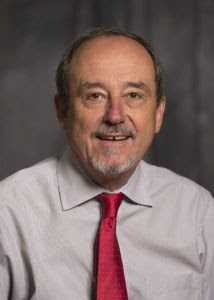
Rick Vari, PhD Professor & Senior Dean for Academic Affairs Virginia Tech Carilion School of Medicine Roanoke, Virginia, USA
Why was the Virginia Tech Carilion School of Medicine the right choice for the 2019 IAMSE meeting? We are the right choice for the meeting this year because we did a fabulous conference several years ago and we were already in the queue for a future IAMSE meeting. We had some scheduling issues with our original site for 2019 and we were able to step in and fill the void. We have a wonderful hotel site (at the Hotel Roanoke), and the people who came from all across North America for the Collaborating Across Borders V: An American-Canadian Dialogue on Interprofessional Healthcare and Practice, in 2015 really enjoyed it. As a relatively new medical school, we are excited about continuing our growing success in medical education; hosting the IAMSE meeting is a real honor for us.
What opportunities will attendees see in Roanoke that they’ve not seen in years past? Roanoke is a beautiful city to have a conference. We’ve localized the venue, which is a major goal for IAMSE. Attendees and exhibitors will appreciate the layout of the conference site. We are adjacent to the Roanoke Market Square with restaurants, breweries, and shopping featuring local items. There are just lots of opportunities for networking and entertainment. The program is outstanding with presentations and sessions on current and future challenges facing health sciences educators. International abstract submission is up, so more colleagues from other parts of the world may be attending. Increased student participation will be another highlight. This year, IAMSE is also hosting a Taste of Roanoke Street Fair which will replace the annual gala dinner. IAMSE 2019 is going to be a very easy conference to attend. If you can stay for the Grand Extravaganza on Tuesday afternoon it is going to be very special with a hiking trip to a beautiful location on the Blue Ridge Parkway and a visit to the Ballast Point brewery (East Coast operation) for dinner.
Can you tell me more about this new event? We are blocking off the Market Square in downtown Roanoke. We will have tastes of local food, beverages, and music. This is a chance to interact in a casual fun setting with lots of local food and a live band! It’s going to be a lot of fun.
What session or speaker are you most looking forward to this year? I’m looking forward to, of course, the Board of Directors and Committee Chairs meeting. I’ve enjoyed being president and interacting with the Board and Committee Chairs in this planning session provides IAMSE with a sense of solid direction. The plenary sessions also look very strong. I’m interested in the Gen Z session (Generation Z: The New Kids on the Block) and How to Use Disruptive Technology to Make Education Better – Not Just Different.
It sounds likes there is much to look forward to this year. Anything else you’d like to share? The local response from the other medical schools in the area in support of the IAMSE meeting in Roanoke has been very strong. As a new school, this is a tremendous opportunity for us and the other medical schools in the area to get better acquainted.
To learn more about the 2019 IAMSE Annual Meeting, including the plenary speakers, workshops and networking opportunities, or to register, please visitwww.IAMSEconference.org.
Reserve your spot before March 15 to ensure the Early Bird Discount!
The IAMSE booth will be exhibiting at the annual winter meeting of the Group for Research in Pathology Education (GRIPE) in New Orleans, LA on January 24-26, 2019. IAMSE Association Manager Julie Hewett will also be delivering a pre-conference workshop titled, “Using Social Media to Disseminate Your Scholarly Work.” If you plan on attending this meeting, don’t miss this session and do not forget to swing by the IAMSE booth and say hello!
Information on the GRIPE Meeting can be found here. We look forward to seeing you there!
We are pleased to announce that registration for the 23rd Annual Meeting of IAMSE, to be held June 8-11, 2019 in Roanoke, VA, USA, is now open. At this annual meeting of the International Association of Medical Science Educators (IAMSE) faculty, staff and students from around the world who are interested in medical science education join together in faculty development and networking opportunities. Sessions on curriculum development, assessment and simulation are among the common topics available at the annual meetings.
Featured plenary speakers include Don Cleveland, Claudia Krebs, Craig Lenz and Geoff Talmon.
Our Association is a robust and diverse set of educators, students, researchers, medical professionals, volunteers and academics that come from all walks of life and from around the globe. Each month we choose a member to highlight their academic and professional career and see how they are making the best of their membership in IAMSE. This month’s Featured Member is Kevlian Andrew.
Kevlian Andrew, MD, MBA Assistant Professor Department of Anatomical Sciences St. George’s University School of Medicine Grenada, West Indies
How long have you been a member of IAMSE? I have been an IAMSE member since 2023.
Looking at your time with the Association, what have you most enjoyed doing? What are you most looking forward to? During my time with the Association, what I have enjoyed most is being able to meet and share ideas with so many brilliant educators. The spaces for discussion have not been limited to just the conferences (which I’ve enjoyed for the past 3 years) but also extends to the various platforms IAMSE provides for meetings like the CoGs. What I am looking forward to most is continuing to build that network and dialogue at the next conference.
What interesting things are you working on outside of the Association right now? At the moment, I am working on leveraging AI in my own educational practices to not only save time, but also improve the educational resources I can provide to students. I have had to move past my initial fear and have become increasingly intrigued by how this tool can be used to enhance medical education. I am also interested in finding ways educators can help students “see” and “make” connections across the curriculum. The differences in the perspectives of faculty and students (based on their varied exposure to and comfort level with information) is something I have recently become more attuned to and I’m exploring in the hopes of identifying ways to bridge the gap.
As an IAMSE Ambassador, what do you most enjoy about being a part of that? As an ambassador, it is a privilege to be connected with motivated educators from across the globe who are doing great things in their respective regions. It has been inspiring to hear and learn from them as it shows you what possibilities do exist.
This year, the Professional Development Workshops (PDWS) are offered across five different themes. Participants will receive a Certificate of Workshop Attendance for each workshop completed. Participants who complete two workshops within the same theme will receive a Certificate of Series Attendance listing both workshops and the overarching theme. The themes for the 2026 PDWS are:
AI in Health Professions Education
Engaging Students with Coaching and Outreach
Assessment & Evaluation
Methods for Health Sciences Education Research
Integrating Basic Science and Clinical Medicine
Below, we look at the Methods for Health Sciences Education Research Professional Development Workshops:
Methods for Health Sciences Education Research
Workshop 1: Quantitative Research in Medical Education When: Saturday, June 6, 2026, 8:00 AM – 11:00 AM EDT Presented by:Sateesh Arja, Praveen Kottath Veetil, and Amina Sadik
This workshop guides participants through both the principles and practices of quantitative research methods in medical education. Participants will learn how to develop questionnaires, rating scales, and observational studies. You will understand the concepts of reliability and validity, as both are essential for publishing findings. The workshop will provide you with the tools to understand your data, describe it adequately, and present it in a meaningful way, to help ensure informed decision-making consistent with the information the data provides. Participants are also encouraged to attend Workshop 2, which focuses on mixed methods, to gain a comprehensive understanding of current research approaches in medical education.Workshop 2:Mixed Methods in Health Sciences Educational Research When: Saturday, June 6, 2026, 12:30 PM – 3:30 PM EDT Presented by: Sateesh Arja, Machelle Linsenmeyer, and Amina Sadik
This foundational workshop aims to provide a fresh perspective on educational issues, problems, and research. The presenters will introduce you to a range of research methods for collecting qualitative data. This will enable an understanding of how these methods can be applied in an educational environment. The presenter will guide you through the process of Mixed Methods Research and Evaluation, including research designs and Sampling in Qualitative Research Methods. Participants are invited to take part in Workshop 1 on quantitative research in the morning to gain a deeper understanding of quantitative methodologies, which form an essential component of mixed-methods research.
For more information on both of these Methods for Health Sciences Education Research PDWS sessions, including presenter information, key learning objectives, and workshop schedules, click here. (Each PDWs theme has it’s own tab).
All PDWS will take place on Saturday, June 6, 2026. Registration for each workshop will be an additional fee of $140.00 USD during registration. Already registered? You can still add PDWS to your schedule by modifying your registration. To do so, you may click here.
If you have any questions or would like assistance adding a workshop to your schedule, please contact support@iamse.org.
Don’t forget to register before the Early Bird deadline on Friday, April 1 to receive a discount on registration costs!
IAMSE Communities of Growth (CoGs) are ongoing groups of like-minded individuals who want to informally get together to connect over an area or topic of interest. A Community of Growth is not directly connected to any Committee and is self-organized, and all CoGs are open to all. For more information on IAMSE CoGs, click here.
The AI CoG and Black Medical Educators CoG have upcoming meetings! Below are the details for each meeting.
AI CoG
The AI CoG meeting on Zoom will take place at Noon (12 PM) EDT on Wednesday, April 1, 2026. IAMSE AI CoG meetings take place regularly at 12 PM ET on the first Wednesday of each month. For information on how to join the AI CoG, email Steve Garwood at garwoods@rowan.edu.
Drs. Leah Hammer and Carmel McNicholas-Bevensee on the AI Learning Collaboratives
Drs. Mari Hopper and Mark Hernandez on the AI Tools Application Workshops
The full agenda can be viewed at AI CoG 4/1/26 Agenda. Join us for an engaging AI CoG discussion. As a member-based group, your voice is important! See you April 1!
To join the April AI CoG Zoom meeting, click here. Meeting ID: 966 6621 1082 Passcode: 361577
Black Medical Educators CoG
The IAMSE Black Medical Educators CoG meeting will take place at 12:30 PM EDT Friday, May 1, 2026. IAMSE Black Medical Educators CoG meetings take place quarterly at 12:30 PM ET on the first Friday in May, August, November, and February. If you are interested in learning more about this CoG and/or how to become a member, please contact Jacqueline Powell at jpowell@msm.edu.
To join the May Black Medical Educators CoG Zoom meeting, click here. Meeting ID: 945 0993 9814 Passcode: 054506
As a reminder, IAMSE is pleased to announce that applications for the 2026 Medical Educator Fellowship (MEF) Program are now being accepted! IAMSE is once again offering members and non-members the option of beginning the MEF Program during the IAMSE 2026 Annual Conference.
The primary goal of the MEF is to support the development of well-rounded healthcare education scholars through a program of targeted professional development and application of learned concepts to mentored research projects. The program is designed for healthcare educators from all backgrounds who wish to enhance their knowledge and productivity as educational scholars.
Applicants for the next cohort will be accepted until April 15, 2026. To submit your application, please click here. For questions about the Fellowship or how to apply, please contact support@iamse.org. We thank you for your interest and look forward to supporting you in achieving your professional goals in educational scholarship.
Rethinking Psychological Safety: Exploring “Educational Safety” Through Learners’ Experiences in a Peer Mentorship Context
By Laura Nimmon, PhD
We are excited to welcome Dr. Laura Nimmon, Associate Professor and Scientist at the University of British Columbia, who will present Rethinking Psychological Safety: Exploring “Educational Safety” Through Learners’ Experiences in a Peer Mentorship Context. The session will take place on Thursday, April 2, 2026, at 12:00 PM EDT, for the fifth and final week of the IAMSE 2026 Spring Webcast Audio Seminar Series titled “‘Tough But Fair’ Standards with Support: Empowering Success.”
This series is tailored for medical educators, particularly those teaching in the pre-clerkship curriculum. We’ll explore how to set ambitious, yet achievable, standards for your students, fostering the rigorous foundation future physicians need. Beyond just raising the bar, this series provides you with practical strategies to ensure your students not only meet these high expectations, but truly excel. Discover how to balance a demanding curriculum with the essential guidance that empowers the next generation of medical professionals.
The full IAMSE Spring WAS schedule can be found on the website.
Below we look at the fifth week’s presentation:
Laura Nimmon, PhD
Rethinking Psychological Safety: Exploring “Educational Safety” Through Learners’ Experiences in a Peer Mentorship Context
Presenter: Laura Nimmon, Associate Professor and Scientist at the university of British Columbia Session Date & Time: April 2, 2026, at 12:00 PM EDT Session Description: Psychological safety is widely recognized as essential to effective learning in health professions education, yet much of the literature defines it by its absence—focusing on mistreatment rather than exploring learners’ own conceptions of what psychological safety is. In this talk, I present findings from a study exploring how medical students experience psychological safety within a peer mentorship learning context. Students described safety as “not feeling judged,” which allowed them to be more present, take learning risks, and build authentic relationships. I propose reframing psychological safety as educational safety—a relational construct that can help us build learning environments that foster trust, mentorship, vulnerability, and support.
In 2024, IAMSE refreshed its introductory course in educational principles, previously known as Essential Skills in Medical Education (ESME) to Foundations of Health Professions Education (to be known as the Foundations course).
With the increasing professionalization of medical education, the need for faculty in the healthcare professions to have training in educational principles is widely recognized. While many institutions worldwide offer certificate or Master’s degree courses in medical education, there is a lack of accredited basic level courses. The new Foundations course has been designed to meet the need for an entry level survey of principles in health professions education. Foundations will be of particular interest to faculty who are involved with health professions education for the first time, or who have been given some new responsibilities or assignment relating to teaching. Others will find this course useful as a refresher course or update.
The course is led by two seasoned educators and long-time IAMSE members:
Aviad Haramati, PhD, is a Professor of Physiology and Medicine, and Director of the Center for Innovation and Leadership in Education (CENTILE), at Georgetown University Medical Center. He served as IAMSE’s first president and received the Distinguished Scholar Award, as well as the Edward P. Finnerty Lifetime Achievement Award from IAMSE.
Amber J. Heck, PhD, is Associate Professor of Biomedical Sciences at the University of North Texas Health Science Center. She served as Program Chair for the 2023 IAMSE Conference and received the 2020 IAMSE Early Career Award of Excellence in Teaching and Innovation.
As a reminder, IAMSE is pleased to offer the course, which will start Friday, June 5, 2026, at 9:00 AM EDT, a day before the Annual Conference, and it is designed to be specifically relevant to medical science educators. Successful completion of the Foundations course is a pre-requisite for the IAMSE Fellowship Program.
Additional Foundations Course details and registration information can be found by clicking here.
Don’t forget to register before the Early Bird deadline on Wednesday, April 1 to receive a discount on registration costs!
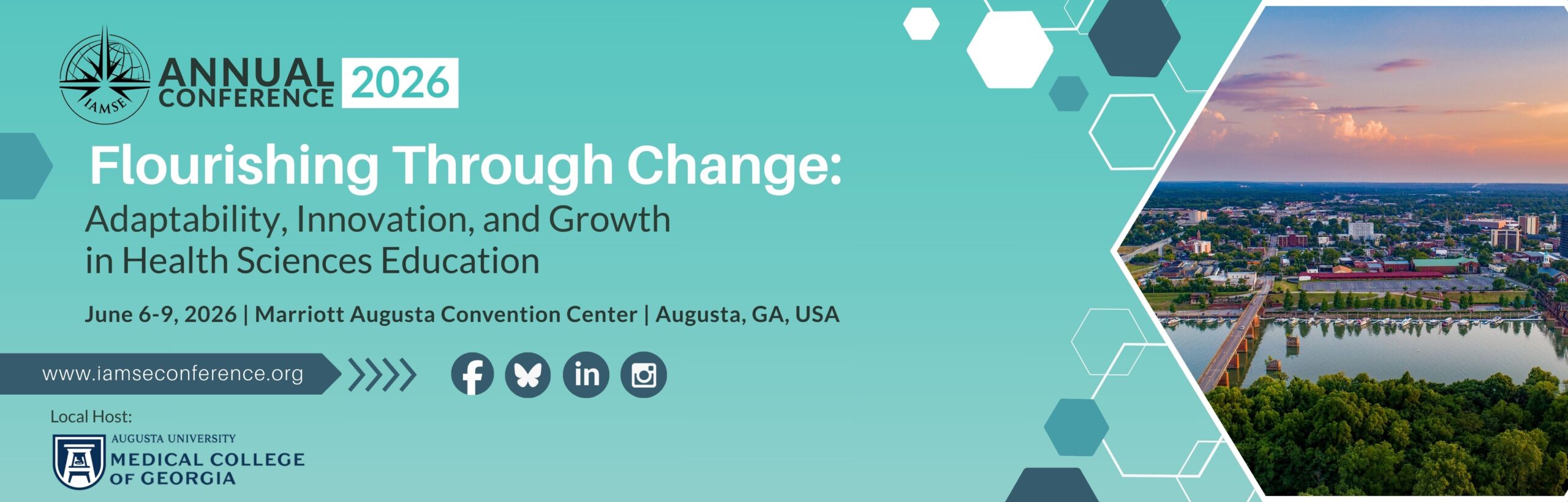
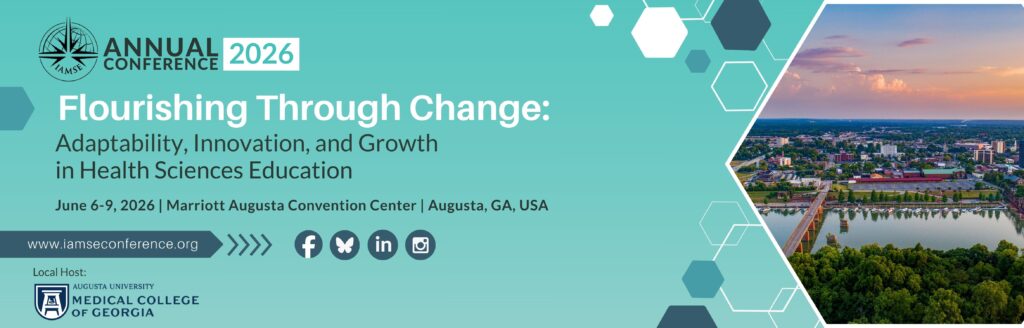
As a reminder, registration for the 30th Annual Conference of the International Association of Medical Science Educators (IAMSE) is OPEN! The annual conference is to be held June 6-9, 2026 in Augusta, Georgia, USA, at the Augusta Marriott at the Convention Center. Faculty, staff and students in health sciences education from around the world will join together at the IAMSE Annual Conference to engage in faculty development and networking opportunities. Sessions on curriculum development, assessment, and simulation are among the common topics available at the conference.
DON’T FORGET! The Early Bird Deadline to register for #IAMSE26 is 11:59 PM EDT Wednesday, April 1, 2026.
Featured plenary speakers include Kimara Ellefson (Kern National Network for Flourishing in Health, United States), Dr. David Rogers (University of Alabama at Birmingham, United States), Dr. Ken Masters (Sultan Qaboos University, Oman), and Dr. Adaira Landry (Harvard Medical School, United States).
This year, the Professional Development Workshops (PDWS) are offered across five different themes. Participants will receive a Certificate of Workshop Attendance for each workshop completed. Participants who complete two workshops within the same theme will receive a Certificate of Series Attendance listing both workshops and the overarching theme. The themes for the 2026 PDWS are:
AI in Health Professions Education
Engaging Students with Coaching and Outreach
Assessment & Evaluation
Methods for Health Sciences Education Research
Integrating Basic Science and Clinical Medicine
Below, we look at the Engaging Students with Coaching and Outreach Professional Development Workshops:
Engaging Students with Coaching and Outreach
Workshop 1: Evidence-Based Coaching Techniques to Help Preclinical Students Through the Learning Paradigm Shift from Memorization to Application When: Saturday, June 6, 2026, 8:00 AM – 11:00 AM EDT Presented by:Richard Gonzalez, Timothy Le, and Jonathan Wisco
The workshop will begin with an introduction to principles of student-centered perspectives to the learning process, and the importance of being cognizant of student potential, skills, and interests, as well as the demographic backgrounds, intersectionalities, and insecurities. Participants in the workshop will be able to define and recognize concepts of dual-processing theory, and how the so-called “curse of knowledge” can contribute to learning and coaching environments.
Workshop 2: Establishing, Sustaining, and Evaluating the Impact of Outreach and Service-Learning on Preclinical Student Professional and Personal Development When: Saturday, June 6, 2026, 12:30 PM – 3:30 PM EDT Presented by: Arlin Arias, Richard Gonzalez, Kirsten Porter-Stransky, Carolina restini, Peter Vollbrecht, Tracey Weiler, and Jonathan Wisco
This foundational workshop will help preclinical and clinical instructors understand the importance of outreach/service-learning for preclinical education and learner professional/personal development. Participants will learn how to design service-learning experiences that cultivate professional identity and meaningful community impact. The workshop will introduce practical and straightforward toolkits to align with goals, set up reciprocal partnerships, and track outcomes that participants can use to address their institution’s program(s) impact on preclinical learners and community partners. The participants will then work in small groups with facilitators to address core establishment plans, sustainability elements, and/or evaluation for their program needs.
For more information on both of these Engaging Students with Coaching and Outreach PDWS sessions, including presenter information, key learning objectives, and workshop schedules, click here. (Each PDWs theme has it’s own tab).
All PDWS will take place on Saturday, June 6, 2026. Registration for each workshop will be an additional fee of $140.00 USD during registration. Already registered? You can still add PDWS to your schedule by modifying your registration. To do so, you may click here.
If you have any questions or would like assistance adding a workshop to your schedule, please contact support@iamse.org.
Don’t forget to register before the Early Bird deadline on Friday, April 1 to receive a discount on registration costs!
We are excited to welcome Dr. Katherine Muenks, Associate Professor and Louise Spence Griffeth Fellow at the University of Texas at Austin, who will present Faculty/Instructor Mindset Beliefs. The session will take place on Thursday, March 26, 2026, at 12:00 PM EDT, for the fourth week of the IAMSE 2026 Spring Webcast Audio Seminar Series titled “‘Tough But Fair’ Standards with Support: Empowering Success.”
This series is tailored for medical educators, particularly those teaching in the pre-clerkship curriculum. We’ll explore how to set ambitious, yet achievable, standards for your students, fostering the rigorous foundation future physicians need. Beyond just raising the bar, this series provides you with practical strategies to ensure your students not only meet these high expectations, but truly excel. Discover how to balance a demanding curriculum with the essential guidance that empowers the next generation of medical professionals.
The full IAMSE Spring WAS schedule can be found on the website.
Below we look at the fourth week’s presentation:
Katherine Muenks, PhD, BS
Faculty/Instructor Mindset Beliefs
Presenter: Katherine Muenks, Associate Professor and Louise Spence Griffeth Fellow at the University of Texas at Austin Session Date & Time: March 26, 2026, at 12:00 PM EDT Session Description: In this talk, I will discuss my research on faculty mindsets, including evidence that these mindsets matter for students’ psychological and academic outcomes, ways in which faculty communicate and their mindsets to students, and implications for teaching practice.
As a reminder, we are excited to announce that the IAMSE Board of Directors has approved the AI in Health Professions Education (AI in HPE) Course, a comprehensive, six-month professional development program that guides health professions educators from foundational AI skillsto real-world implementation at their home institutions.
Applications are now open for our inaugural cohort of 25 participants, who will begin the program at the IAMSE 2026 Annual Conference in June.
Course Enrollment Options:
There will be two standalone AI Professional Development Workshops (PDWS) as pre-conference sessions.
PDWS 1: AI Foundations & Tool Exploration (3 hours)
PDWS 2: Advanced Applications in Health Professions Education (3 hours)
These workshops can be attended individually as standalone sessions. Educators who want targeted AI Skill development can register for either or both through the pre-conference workshop system.
The AI Foundations and Advanced Applications workshops serve as the required in-person foundation for the new comprehensive AI in HPE Course. The full course adds:
Mentored Implementation Project (3-6 months with structured support)
Office hours and 1-on-1 consultations with course directors and selected faculty
AI Community of Growth integration for ongoing peer support
Total course commitment: 30-35 hours.
Limited to 25 participants: Application-based selection.
Application Requirements:
500-word project proposal describing an educational opportunity and proposed AI application.
Professional bio highlighting your educational role.
Confirmation that you will attend (or have attended*) the prerequisite Workshops 1 & 2. * Participants that attended the 2025 inaugural AI in HPE Professional Development Workshops are welcome to apply.
IAMSE is pleased to invite you to join us for the Fifth Annual IAMSE Virtual Forum. The Forum will take place October 20-22, 2026. Join us as we engage with a diverse network of international health science educators to gain insights from the global community.
Presentation Descriptions
Ignite talk: Throughout the forum, there will be three ignite talks. These sessions are intended to be highly interactive to ignite and inspire discussions around key ideas or emerging topics. Ignite Presenters are selected by the Virtual Forum Program Committee.
Lightning Talks: These short sessions, 7-minute presentations with 7-minutes of questions and answers, provide all scholars with a chance to share their works including works in process.
Important Deadlines
July 31, 2026 – Lightning Talk Abstract Deadline August 2026 – Registration Open! September 1, 2026 – Lightning Talk Notification Deadline September 15, 2026 – Early Bird Deadline September 15, 2026 – Presenter Registration Deadline* October 2026 – Presentation Schedule Finalized October 20-22, 2026 – IAMSE 2026 Virtual Forum
*Any presenter who is not registered by this date will have their name pulled from the forum program. If the presenter is the only presenter listed, their session will be pulled from the forum program.
Tentative Forum Schedule
Schedule subject to change, the finalized schedule will be listed on the Virtual Forum registration website when it opens later this year
Date
Session
Start Time (EDT)
End Time (EDT)
Tuesday, October 20, 2026
Virtual Help Desk
9:00 AM
9:30 AM
Tuesday, October 20, 2026
IAMSE Spotlight
9:45 AM
10:00 AM
Tuesday, October 20, 2026
Ignite Talk
10:00 AM
11:00 AM
Tuesday, October 20, 2026
Break
11:00 AM
11:15 AM
Tuesday, October 20, 2026
IAMSE Spotlight
11:15 AM
11:30 AM
Tuesday, October 20, 2026
Lightning Talks
11:30 AM
12:30 PM
Tuesday, October 20, 2026
Break
12:30 PM
1:00 PM
Tuesday, October 20, 2026
IAMSE Spotlight
1:00 PM
1:15 PM
Tuesday, October 20, 2026
Lightning Talks
1:15 PM
2:15 PM
Wednesday, October 21, 2026
Virtual Help Desk
8:00 AM
8:30 AM
Wednesday, October 21, 2026
IAMSE Spotlight
8:45 AM
9:00 AM
Wednesday, October 21, 2026
Lightning Talks
9:00 AM
10:00 AM
Wednesday, October 21, 2026
Break
10:00 AM
10:15 AM
Wednesday, October 21, 2026
IAMSE Spotlight
10:15 AM
10:30 AM
Wednesday, October 21, 2026
Ignite Talk
10:30 AM
11:30 AM
Wednesday, October 21, 2026
Break
11:30 AM
12:00 PM
Wednesday, October 21, 2026
IAMSE Spotlight
12:00 PM
12:15 PM
Wednesday, October 21, 2026
Lightning Talks
12:15 PM
1:15 PM
Thursday, October 22, 2026
Virtual Help Desk
9:00 AM
9:30 AM
Thursday, October 22, 2026
IAMSE Spotlight
9:45 AM
10:00 AM
Thursday, October 22, 2026
Lightning Talks
10:00 AM
11:00 AM
Thursday, October 22, 2026
Break
11:00 AM
11:15 AM
Thursday, October 22, 2026
IAMSE Spotlight
11:15 AM
11:30 AM
Thursday, October 22, 2026
Lightning Talks
11:30 AM
12:30 PM
Thursday, October 22, 2026
Break
12:30 PM
1:00 PM
Thursday, October 22, 2026
IAMSE Spotlight
1:00 PM
1:15 PM
Thursday, October 22, 2026
Ignite Talk
1:15 PM
2:15 PM
Thursday, October 22, 2026
Virtual Forum Close
2:15 PM
2:30 PM
Are you in a different time zone? Click here to see what time the sessions will be for you!
The 30th Annual IAMSE Conference will feature a host of new focus sessions throughout the entire conference. Below, we look at the focus sessions being offered during the Sunday block!
Each of the following focus sessions will take place from 9:45 AM – 11:15 AM EDT Sunday, June 7, 2026, during the IAMSE 2026 Conference. Click the links for each session for more information!