As a reminder, IAMSE is currently seeking nominations and self-nominations of candidates to serve on the IAMSE Board of Directors. International members are particularly invited.
The Board of Directors is the governing body that determines the direction of IAMSE and all our various programs and activities. This Spring, three of the Director positions become subject to election. The term for an IAMSE Director is for three years, renewable once.
The formal “job descriptions” for IAMSE Director are posted here. To submit your nomination or self-nomination by November 20, 2020 at 5 PM ET, please click here.
Thank you,
IAMSE Nominating Committee
News
As we prepare for our 2021 meeting, we want to hear from YOU!
Don’t miss your opportunity to help shape the IAMSE 2021 Annual Meeting by giving us your feedback. Are you planning to join us in Cancun in June? Is your university allowing travel in 2021? Has COVID-19 impacted funding at your institution?
Please take a few moments to respond to our survey. Your feedback will help IAMSE put together a robust event that offers exactly what our attendees need when they need it.
Please submit your responses by Friday, October 30 for consideration by the Board of Directors.
Save the Date for the Winter 2021 Webcast Audio Seminar Series
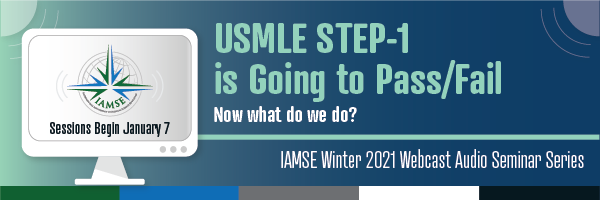
Join us every Thursday in January and the first Thursday in February for the IAMSE Winter 2021 Webcast Audio Seminar Series.
Now what do we do?
USMLE STEP-1 is going to Pass/Fail
The debate about the pros and cons of the United States Medical Licensing Examination (USMLE) Step 1 score reporting has been ongoing for over a decade. The issues are complicated and both positive and negative aspects of score reporting can be cited, depending on where you are positioned in the UME-GME continuum. In March of 2019, the Association of American Medical Colleges (AAMC), American Medical Association (AMA), the Educational Commission for Foreign Medical Graduates (ECFMG), the Federation of State Medical Boards (FSMB) and the National Board of Medical Examiners (NBME) convened a multi-stakeholder Invitational Conference on USMLE Scoring (InCUS) to explore issues and concerns regarding the USMLE Step 1 exam and to consider recommendations specific to USMLE score reporting and the broader system of transition from UME to GME.
A general consensus emerged: the current UME-GME transition system is flawed and not meeting the needs of stakeholders. As a result of further stakeholder discussions, the USMLE decided that beginning with the administration of Step 1 in 2022, the exam will be scored as pass/fail and no numeric score will be reported. This decision will undoubtedly impact faculty, students, and programs across the UME-GME continuum.
In this five-part series, recognized experts from the various stakeholder groups will present and discuss the impact of this decision, identify challenges to their respective programs and explore creative ways to address the consequences of this important medical education milestone. These thought-provoking sessions will include the perspectives of allopathic and osteopathic residency program directors, basic science faculty, undergraduate medical education curriculum designers, clinical educators, and programs that involve international medical students matriculating to the United States.
As always, IAMSE Student Members can register for the series for FREE! Email support@iamse.org for more information.
Details about the series will be coming soon, so keep an eye on your inbox. For more details on the upcoming Winter 2021 series or our archives, please visit www.iamse.org.
Medical Science Educator Article Review by Alice Fornari
A Review from Medical Science Educator
from Dr. Alice Fornari
This month the IAMSE Publications Committee review is taken from the article titled Medical Improvisation Training for all Medical Students: 3-year experience, published online in Medical Science Educator, (December 2019), by David Fessell, Erin McKean, Heather Wagenschutz, Michael Cole, Sally A. Santen, Robert Cermak, Katie Zurales, Stephanie Kukora, Valeri Lantz-Gefroh, Evonne Kaplan-Liss & Alan Alda
I have been intimately involved in the development, implementation and evaluation of our Zucker SOM at Hofstra/Northwell SOM since we planned to open and now have a 8 year history. This short communication is has a strong author line from diverse medical schools, with one being a new school. The senior author is the famous Alan Alda who has dedicated his professional focus to communication skills of physicians and scientists to assure patients can understand the scientific and healthcare messages delivered by the medical community. I am very excited to share the reported study aligning a medical improvisation as a pedagogy to help our young medical students practice communication skills and learn skills that can be transferred to patient care settings. This is a win-win!
The background of the article confirms the importance of communications curriculum for our students that focuses on acquiring knowledge, skills and of course transforming attitudes to assure they value the concepts. The transfer of a theater training modality, specifically improvisational training, to support communication education is exciting and fun! This pedagogy is linked to education theory we should all value: Kolb’s experiential learning and Bandura social learning theory. These two theories assure learners are actively engaged in the learning paradigm and learning with peers.
The activity was initiated in 2015, 2016, and 2017 with 150, 177 and 167 students respectively in a workshop format with the students. In 2015 it was a three-hour workshop for all third-year medical students led by the Alda Center trainers and in 2016 and 2017 trained facilitators held a 2.5-hour workshop for or 3rd year medical students. There were 5 improvisation exercise per workshop.
Post workshop data collection from students included satisfaction with the workshop, perceived impact on teamwork skills, and insight into their role as a physician. Only for the 2016 class was there a 3-month follow-up survey on the improvisation skills they used in clinical rotations.
Results were positive for verbal and nonverbal communication skills and transfer to the clinical setting.
As educators we know from experience and the literature patients highly value outstanding communication skills from physicians who provide care in clinical settings. Teaching these skills is often seen as a soft science and the curriculum is not taken as seriously by medical students despite this strong desire of patients to have physicians listen to their story and gather data about who they are as a person and have a relationship beyond a management plan to treat a disease. To engage students in their learning of new skills, especially in their clinical years of their education, is challenging and if a pedagogy can be experiential, social and fun it seems like a win/win to brand our students with enhanced skills that transfer to the patient care setting. Yes, this requires trained facilitators who are willing to learn new skills themselves and take a risk with their learners to move from traditional learning to a shared approach of humanities-based education to support creative learning modalities. Medical educators who can leave their comfort zone will enjoy the experiences and be role models for their students.
Alice Fornari, EdD, RDN
Professor, Science Education, Occupational Health, Family Medicine
Associate Dean, Educational Skills Development,
Zucker SOM at Hofstra/Northwell
Vice President, Faculty Development, Northwell Health
Director, MSED and Advanced Certificate in Health Professions Education,Hofstra University
Member IAMSE Publications Committee
Registration Open – New Educator & Scholars Training Workshop for Faculty!
Join IAMSE for this online workshop for faculty! Developed and presented by ScholarRx, the session will provide faculty participants with an introductory, hands-on experience in applying Kern’s Six-Step model to design a complete education activity with appropriate pedagogic strategies. Participants will also explore models of converting medical education design and development into scholarship.
New Educator and Scholars Training (NEST) Workshop for Faculty Sponsored by ScholarRx
Presenters: Elisabeth Schlegel, Colleen Croniger, Yun Weisholtz and Tao Le
Date: Nov 12, 2020
Time: 11:00 AM – 2:00 PM Eastern
After participating in this session, attendees should be able to:
- Describe a framework for medical education professional development
- Discuss and apply principles and best practices for curriculum design, pedagogic strategies, and educational scholarship
- Identify and synthesize themes that integrate across major domains of medical education professional development.
Spots are limited for this special workshop so make sure you reserve your seat today! If you have any questions please feel free to reach out to support@iamse.org.
IAMSE Program Committee Now Seeking Volunteers for 2022 Annual Meeting
The time has come to begin planning the 2022 Annual IAMSE Meeting to be held in Denver, Colorado, USA! The first step in the process is to form the Program Committee.
The role of the Program Committee is to establish a theme and schedule for the program, select and invite pertinent speakers, and collaborate on various tasks as needed in order to provide the membership with an outstanding annual meeting. Your availability for a one-hour monthly Zoom video meeting and ready accessibility by email from January 2021 through the program in June 2022 is expected, in addition to great ideas and a collegial spirit!
For the committee, we are seeking a broad representation of professional educators, basic scientists, clinical scientists, and instructional technologists from around the world. The names of participating members will be credited in the conference program.
If you would like to be considered for a position on the Program Committee, please submit a brief statement of your interest and qualifications online here by November 15, 2020. We would like to complete selections by December 15 so we begin our meetings by phone in January 2021.
We hope that you will consider becoming involved in this important and collegial work. For additional information or questions please contact support@iamse.org.
Thank you,
Maria Sheakley
2022 Annual Program Committee Chair
#IAMSE21 Call for Poster & Oral Abstracts Due December 1
The International Association of Medical Science Educators (IAMSE) is pleased to announce the call for abstracts for Oral and Poster presentations for the 25th Annual IAMSE Conference to be held at the JW Marriott Cancun Resort & Spa in Cancun, Mexico from June 12-15, 2021. The IAMSE meeting offers opportunities for faculty development and networking, bringing together medical sciences and medical education across the continuum of healthcare education. New in 2021, IAMSE will be offering registration for the in-person event as well as virtual-only registration.
Submit your abstract here!
Deadline: December 1, 2020
The first time you enter the site, you will be required to create a user profile. Even if you did submit in previous years, you need to create a new account. All abstracts for Oral and Poster presentations must be submitted in the format requested through the online abstract submission site. *Please note that authors of accepted abstracts MUST provide a PDF of the accepted poster or an MP4/MOV of the accepted oral presentation by the early bird deadline. More details will be provided soon.
Students are encouraged to submit!
Students who would like feedback on a draft of their abstract prior to final submission should email it to the Student Professional Development Committee, care of Colleen Croninger at cmc6@case.edu, by November 8, 2020.
There is no limit on the number of abstracts you may submit, but it is unlikely that more than two presentations per presenter can be accepted due to scheduling complexities. Abstract acceptance notifications will be returned in March 2021.
Thank you,
Mark Hernandez
Chair, IAMSE 2021 Program Committee
IAMSE October Featured Member Heather Christensen
Say hello to our featured member
Heather Christensen
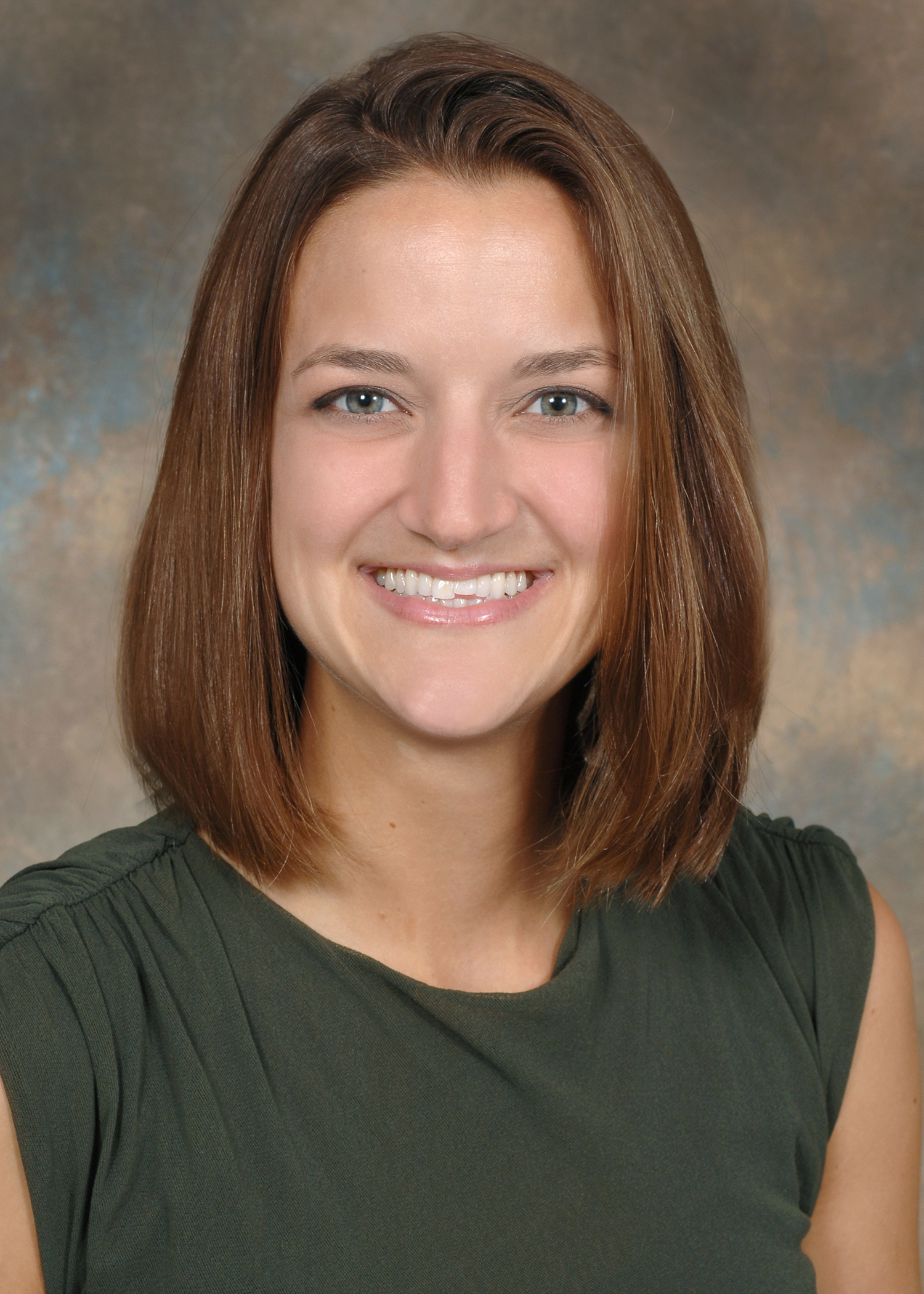
Our association is a robust and diverse set of educators, researchers, medical professionals, volunteers and academics that come from all walks of life and from around the globe. Each month we choose a member to highlight their academic and professional career, and see how they are making the best of their membership in IAMSE. This month’s Featured Member is IAMSE member Heather Christensen, PhD.
Heather Christensen, PhD
Assistant Professor-Educator, Department of Medical Education
The University of Cincinnati College of Medicine
How long have you been a member of IAMSE?
For 1 year. I attended my first IAMSE conference (as well as completed the ESME course) in June, 2019, and became a member in August, 2019 when I began this initiative.
Looking at your time with the Association, what have you most enjoyed doing? What are you looking forward to? Committee involvement, conference attendance, WAS series, manuals, etc.?
As a relational leader, I have been enjoying the new connections made through conference attendance and my involvement with the Professional Development Committee (and the start of EnGAGE). I appreciate how the Association sees value in each member – from students to staff, faculty, or administration – and encourages collaboration.
What interesting things are you working on outside the Association right now? Research, presentations, etc.
Within my institution (University of Cincinnati College of Medicine) I am working on several student research projects, including the impact of gender ratios in small group learning, qualitative analysis of how (faculty and medical student) gender influences clerkship evaluations, and understanding how gender affects medical student self-evaluation.
Some of this work was recently presented for the Sex and Gender Health Education Summit and will be presented at the Women in Medicine conference later this year. I am also collaborating with colleagues on a national survey to assess the gender-equity impact of COVID-19 on medical educator faculty.
Tell us a bit about EnGAGE. What is it, what are the goals of the group, and how can members get involved?
This group was born out of my interest to explore gender equity in medical education on a national level. The idea was brought forth to the professional development committee, and in conversations with this group, it became clear that there was much to explore with regard to all areas of equity and inclusion. In January 2020 – we launched EnGAGE: “Encouraging Growth and Advocacy in Gaining Equity.” Our overall goal is to (1) cultivate awareness of inequities and (2) advance the careers of minority and underrepresented persons in medical education. Our vision is to bolster cross-institutional collaborations that support healthy diversity and inclusivity in medical education, ultimately creating lasting change and equitable leadership in this field. As a new subcommittee, we are seeking input and feedback; IAMSE members can help our group by completing our needs assessment survey (coming soon!) and participating in the workshops and seminars that the group will host at IAMSE annual conferences.
Anything else that you would like to add?
We are excited about this work and welcome any opportunity to collaborate on work (be it educational, institutional, or scholarly) in the arena of diversity, equity, and inclusion.
Want to watch Heather’s IAMSE Cafe session where she discusses EnGage?
View that session here.
#IAMSECafe Welcomes #MedEd Tech Expert Edgar Herrera Bastida!
Stay connected with your colleagues around the globe and join us for this week’s IAMSE Cafe round table discussion. Join our host, Raul Barroso from Universidad Anáhuac as he welcomes Edgar Herrera Bastida (Universidad Anáhuac, Mexico).
Tuesday, October 6, 2020 at 10AM ET – How we are using technology in education? As medical science educators, and those across all disciplines, are shifting their focus to online learning, what are the most effective and engaging technology tools available? This week the IAMSE Cafe welcomes Edgar Herrera Bastida, head of medical simulation Universidad Anáhuac, President of the Mexican Simulation Society (SOMESICS), and member and Fellow of the Society of Simulation and Healthcare to discuss how he uses technology in and out of the classroom.
To join the meeting please click here. The meeting password is IAMSECafe or, if you are calling in from a phone, the numeric password is 778130.
We look forward to seeing you this week!
Check out the #IAMSECafe Archives!
Catch up on the engaging topics and lively discussion presented each week at the IAMSE Cafe all the way back to the very first on March 31! IAMSE keeps an up-to-date archive of each Cafe session in case you couldn’t make the live meeting. Revisit sessions like:
- Leading by Example: Practicing Self-care in a Time of Crisis with Adi Haramati
- How Re-thinking and Re-designing Anatomy Instruction Into the Online Space Can Lead to Better Classroom and Cadaver Lab Learning Experiences with Jon Wisco
- COVID-19 and the New Medical School with Amber Heck and Michael Lee
- Communities of Practice in a Virtual World with James Pickering
View the full archive of sessions here.
Don’t miss upcoming Cafes, presented live on the first and third Tuesday of each month. Join hosts Raul Barroso, Wendy Lackey, Kelly Quesnelle and Jon Wisco as they tackle pertinent and timely topics, including and beyond COVID-19.
The next IAMSE Cafe is scheduled for Tuesday, October 6 at 10am EDT. Zoom call0in information will be sent on Monday. If you have any questions please email support@iamse.org.
A Review from Medical Science Educator from Dr. John Szarek
This month the IAMSE Publications Committee review is taken from the article titled Factors That Determine the Perceived Effectiveness of Peer Feedback in Collaborative Learning: A Mixed Methods Design, published online in Medical Science Educator, (19 May 2020), by Daou, D., Sabra, R. & Zgheib, N.K.
Bill Gates said, “We all need people who will give us feedback. That’s how we improve.” Yet, many times when our learners hear the word “feedback” their first thought is, “Oh no, here it comes!” What drives this disposition of learners toward feedback? In their Medical Science Educator article Dayane Daou, Ramzi Sabra, and Nathalie Zgheib, used a mixed-methods approach to identify factors important in the quality and effectiveness of peer feedback among medical students.
In their study, the authors explored the volume and quality of the written feedback given to students as part of the periodic peer assessment in Team-Based Learning (TBL), and whether it changes with time; the factors that determine the volume and quality; and the learner’ perceptions of the benefits of peer feedback. Preclinical medical students were randomly assigned to 5-6 member TBL teams three times over two years. At the end of each session students completed an anonymous peer evaluation form which included two open-ended questions asking about (1) the single most valuable contribution the person makes to the team and (2) the single most important way the person could more effectively help the team. Students had two opportunities to learn about the value of peer evaluation and how to give effective feedback. The quantitative component included the number of comments each student received and scores on the quality of the comments (0-3) based on a rubric. A thematic analysis of comments obtained during focus group sessions with students constituted the qualitative component of the study.
In general, the number and quality of comments was low. Forty-nine percent to 96% of students received comments with the number of comments per student ranging from 1.27 to 1.90. The top 3 areas of focus for students’ comments were personality traits, participation and cognitive abilities which accounted for about 70% of the comments. The mean quality rating ranged between 1.24 and 1.86. The focus groups revealed several reasons for the low number and quality of comments but two stood out. First, the perception students had that rather than being formative feedback they were evaluative and would be used for judgmental purposes. Second, there was a disincentive to provide constructive feedback to their peers so as not to disrupt their social relationship. Although there was a negative disposition of the students toward feedback, they still perceived the process as very beneficial for personal development. The authors conclude that success of peer evaluation lies in establishing a safe environment for students to feel that they can be forthright and the need for extensive training with periodic enforcement.
Many of us utilize peer evaluation as a requirement in the curriculum positioning it as an episodic event which must be accomplished to satisfy a course or curriculum requirement. This article causes us to rethink how we can encourage learners to relish feedback as a means to being the best healthcare professional they can be.
John L. Szarek, BPharm, PhD, CHSE
Professor and Director of Clinical Pharmacology
Education Director for Simulation
Geisinger Commonwealth School of Medicine
Member IAMSE Publications Committee
FREE New Educator & Scholars Training Workshop for Students!
Join IAMSE for this free, online workshop just for students! Developed and presented by ScholarRx, the session will provide participants with an introductory, hands-on experience in applying Kern’s Six-Step model to design a complete education activity with appropriate pedagogic strategies. Students will also explore models of converting medical education design and development into scholarship.
Presenters: Elisabeth Schlegel, Colleen Croniger, Yun Weisholtz and Tao Le
Date: Oct 17, 2020
Time: 11:00 AM – 2:00 PM Eastern
Date: Oct 17, 2020
Time: 11:00 AM – 2:00 PM Eastern
After participating in this session, student attendees should be able to:
- Describe a framework for medical education professional development
- Discuss and apply principles and best practices for curriculum design, pedagogic strategies, and educational scholarship
- Identify and synthesize themes that integrate across major domains of medical education professional development.
If you have any questions please feel free to reach out to support@iamse.org.