The International Association of Medical Science Educators (IAMSE) is pleased to invite you to join us for the Fifth Annual IAMSE Virtual Forum. The Forum will take place October 20-22, 2026 and provides an opportunity to engage with a diverse network of international health science educators to gain insights from the global community.
Join us at the IAMSE 2026 Virtual Forum as we reframe educational success, moving beyond single metrics toward a holistic interpretation of learner and educator growth. Together, we will explore the transformative power of second chances, reframing failure and remediation as compassionate “on-ramps” and “off-ramps” for professional development. This requires designing holistic programs centered on growth-oriented assessment, feedback, and proactive learner support. Ultimately, we will examine what it means to redefine competence—building the professional identity, collaborative learning, and resilience needed to thrive in an AI-shaped world.
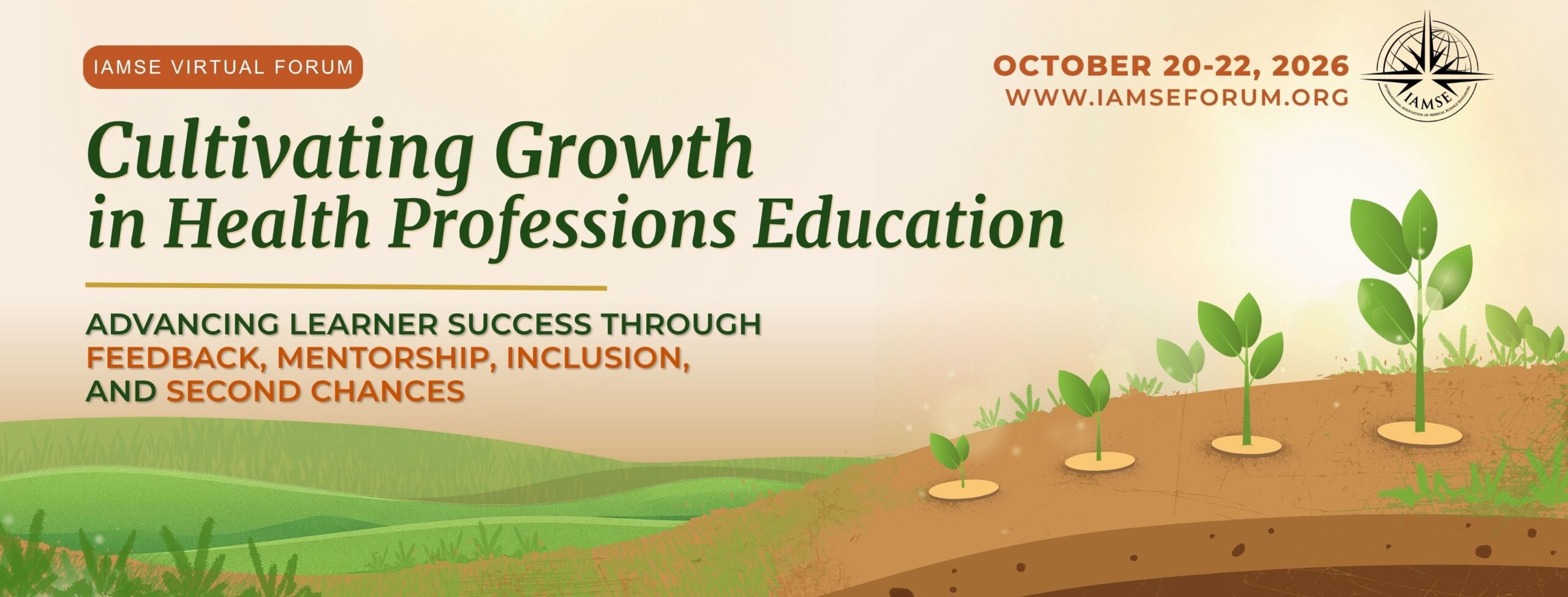
This year’s theme is “Cultivating Growth in Health Professions Education: Advancing Learner Success Through Feedback, Mentorship, Inclusion, and Second Chances”.
Below, we look at one of our Virtual Forum Ignite Speakers, Laurah Turner, Associate Dean for Artificial Intelligence and Educational Informatics at the University of Cincinnati, who will be presenting “Bloom’s 2-Sigma Problem: What AI Can Do for Preclinical Learners”.
Bloom’s 2-Sigma Problem: What AI Can Do for Preclinical Learners

Calvin Chou
University of California, San Francisco
Forty years ago Benjamin Bloom showed that one-on-one tutoring moves a learner two standard deviations, but the resources required to scale one-on-one tutoring have historically been prohibitive. Generative AI offers a potential solution to Bloom’s 2-sigma problem, but not without risks. Advanced AI technologies can provide preclinical students with on-demand practice and immediate feedback; however, the same tools can eliminate the productive failure that practice is for if they are not thoughtfully integrated into learning workflows. This Ignite talk draws on four tools built and studied with first- and second-year students at the University of Cincinnati, and on an international study of how medical education leaders decide which AI tools reach learners. Tangible examples will illustrate best practices for AI tool development, deployment, and continuous monitoring and evaluation, drawn from the medical education literature and from 2-Sigma Labs. By the end of this session, participants will be able to describe the design conditions under which AI feedback tools support learning, identify the faculty judgment each tool depends on, and name one change they can make in a course they teach.
To read more about Laurah Turner, click here.